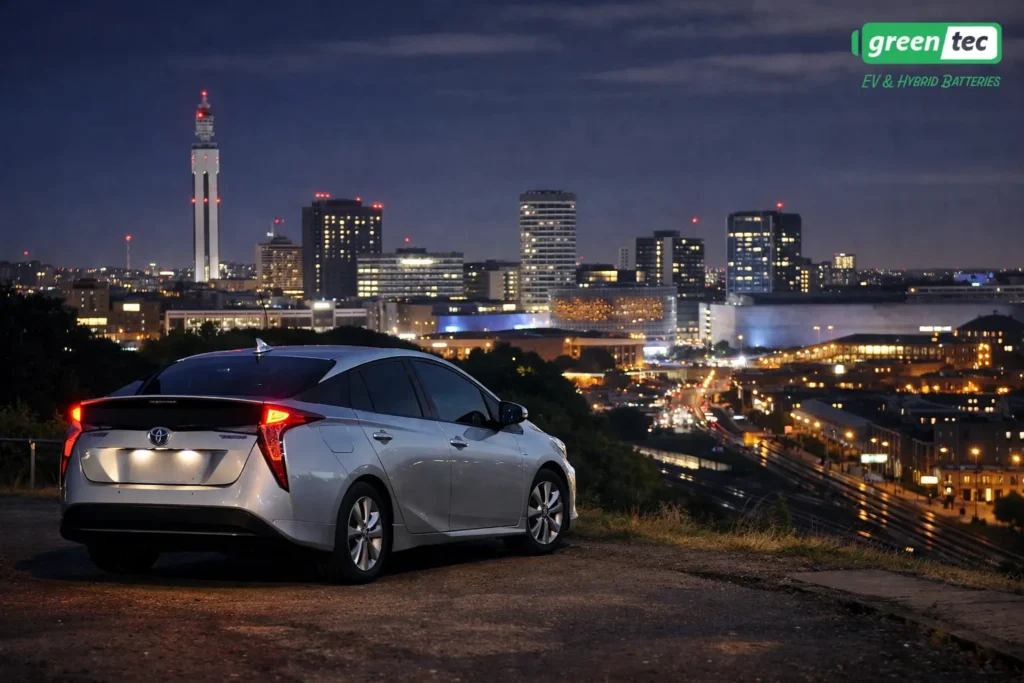


Your Toyota Prius has been doing exactly what you bought it to do. Exceptional fuel economy, low running costs, and a reliability record that makes it one of the most trusted cars on UK roads. Whether you’ve been driving it as a family car, a high-mileage commuter, or a private hire vehicle, it’s probably exceeded every expectation.
But lately something’s off. The fuel economy figures aren’t what they were. The EV mode disappears almost immediately after you set off. Warning lights have appeared on the dashboard that you’ve never seen before.
You’re wondering: “Does my Prius need a new battery, and does it make sense to replace it at this point?”
If you’re a UK Prius owner asking those questions, you’re in exactly the right place. Greentec Auto has served over 300,000 customers worldwide across 13 years of hybrid battery specialisation, and the Prius is the vehicle we encounter more than any other. We understand these cars, their owners, and the very specific decisions that come with Prius battery replacement in the UK.
Here’s everything you need to know.
Why the Toyota Prius Holds a Unique Place in the UK Hybrid Market
The Prius isn’t just another hybrid. It’s the car that made hybrid technology mainstream in the UK and proved that alternative powertrains could be practical, economical, and genuinely desirable for everyday drivers.
Since its UK arrival in the early 2000s, the Prius has sold in enormous numbers. The second-generation model (2004-2009) and third-generation (2010-2015) alone put hundreds of thousands of cars onto British roads. Those vehicles are now 10-20 years old, putting a huge proportion of the UK Prius fleet squarely in the window where battery replacement becomes relevant.
Who Drives a Prius in the UK
The Prius has always attracted a remarkably diverse group of owners:
Private hire and taxi drivers: The Gen 2 and Gen 3 Prius became the vehicle of choice for many UK taxi operators. Exceptional fuel economy and proven reliability made the business case obvious. Many of these cars have accumulated enormous mileages.
High-mileage commuters: Drivers covering significant distances found the Prius’s running costs dramatically lower than petrol or diesel alternatives.
Eco-conscious families: The environmental credentials and low fuel bills attracted families who wanted to reduce their motoring footprint without sacrificing practicality.
Budget-conscious buyers: The strong used Prius market meant many owners bought second or third-hand examples specifically for their low running costs.
What these owners share is an expectation of long-term, low-cost motoring. Battery replacement fits naturally into that mindset because it restores exactly what attracted you to the Prius in the first place.
The Prius’s Hybrid System: What Makes It Different
The Prius uses Toyota’s Hybrid Synergy Drive (HSD), which is more sophisticated than many rival hybrid systems. Understanding it helps you understand why battery health matters so much to the Prius experience.
True electric driving capability: Unlike some mild hybrid systems, the Prius can drive on electric power alone at low speeds. When the battery degrades, this capability diminishes significantly and you feel it immediately.
Seamless engine switching: Toyota’s HSD constantly blends petrol and electric power. A healthy battery enables this fluid transition. A degraded battery forces the petrol engine to run almost continuously.
Regenerative braking: Every time you slow down, the Prius recovers energy and stores it in the battery. Degraded cells can’t hold or use this recovered energy effectively.
Battery as the system’s core: The Prius battery isn’t just an assist — it’s central to how the entire drivetrain functions. When it degrades, the whole car’s character changes.
The Prius battery also differs across generations, which affects replacement considerations. We’ll cover this in detail below.
Prius Battery Lifespan in UK Conditions
The UK market has a massive range of Prius ages and generations in active use. Understanding where your car sits in the battery lifecycle helps you plan sensibly.
Generation by Generation: What to Expect
Second-generation Prius (2004-2009): These cars are now 15-20 years old. Battery replacement on surviving Gen 2 examples is almost universally relevant. Cars that are still running well mechanically very commonly have batteries operating at significantly reduced capacity. Many Gen 2 owners have already replaced batteries once and are considering it again.
Third-generation Prius (2010-2015): Now 10-15 years old, the Gen 3 represents the largest active replacement market in the UK right now. These cars are at peak battery replacement age, with many owners noticing meaningful performance and economy decline.
Fourth-generation Prius (2016-2022): Earlier Gen 4 examples are now 8-9 years old. While some are beginning to show early battery wear — particularly those used for high-mileage private hire work — the majority are not yet at replacement age.
Expected Battery Lifespan
Toyota Prius batteries are genuinely impressive in their longevity. Under normal UK driving conditions, you can reasonably expect:
8-12 years or 100,000-150,000 miles from standard family/commuter use
6-10 years or 150,000-250,000 miles from intensive private hire use, where constant charge cycling occurs
The UK climate is actually favourable for Prius batteries. Our moderate temperatures avoid the extreme heat degradation common in warmer countries and the severe cold stress seen further north in Europe. A well-maintained Prius battery in the UK often reaches the top end of these ranges.
Degradation is gradual rather than sudden. Capacity typically drops to 70-80% within 8-10 years, then declines more noticeably. The car keeps working, but the efficiency and EV capability that define the Prius experience fades progressively.
Real UK Prius Owner Experiences
A Leeds taxi driver contacted us about his 2007 Gen 2 Prius with 267,000 miles. The battery had been replaced once at around 180,000 miles. He was now experiencing the familiar signs again — constant engine running, fuel economy back near petrol-car levels, warning lights appearing after rest periods. The car was mechanically immaculate. Battery replacement was the obvious path forward.
A Bristol family with a 2012 Gen 3 noticed fuel economy had dropped from a regular 55 mpg to around 38 mpg over 18 months. No warning lights initially, just a steady decline they eventually connected to the battery. By the time they contacted us, the warning had appeared and EV mode was lasting seconds rather than minutes.
A Manchester Uber driver had covered 190,000 miles on his 2014 Gen 3. The battery was a livelihood concern — a failing battery meant higher fuel costs eating directly into earnings. For him, replacement wasn’t optional. It was a business decision with a clear return.
Warning Signs Your Prius Battery Needs Attention
The Prius communicates battery problems clearly if you know what to look for. These signs typically appear gradually over months before reaching a critical point.
Dashboard Warning Indicators
Red Triangle Warning: The red triangle with an exclamation mark is the Prius’s most urgent warning signal. When accompanied by battery symptoms, it indicates the hybrid system has detected a problem requiring attention.
Hybrid System Warning Light: A separate indicator specific to the hybrid battery and drive system. This appears when the battery management system logs fault codes related to cell performance or temperature.
“Ready” Light Behaviour: The green READY light should illuminate reliably when you start the Prius. If it fails to appear, flickers, or disappears unexpectedly during driving, the battery management system may be struggling.
State of Charge Bar Abnormalities: The battery bars on your dashboard should move smoothly and predictably. Erratic behaviour, bars that jump from full to empty without warning, or a gauge that sits permanently at the same level all indicate battery issues.
Take any of these warnings seriously. Our free diagnostic assessment identifies exactly which codes are present and what they mean for your specific situation. As we cover in our guide to hybrid battery warning lights, understanding the warning before acting saves money.
Performance Changes You’ll Notice Day to Day
Fuel economy decline: This is usually the first thing Prius owners notice. A significant drop in mpg without any change in driving habits is a strong signal the battery isn’t supporting the engine effectively. Keep a note of your fuel fill-up figures — the trend tells you a lot.
Loss of EV mode: A healthy Prius glides silently on electric power at low speeds, in slow-moving traffic, and during gentle acceleration. When battery capacity drops significantly, EV mode lasts seconds instead of the minute or more you’re used to.
Engine running at standstill: At traffic lights or in stationary queues, a healthy Prius switches the engine off. If your engine is running constantly in situations where it used to be silent, the battery can no longer hold sufficient charge to support engine-off operation.
Sluggish acceleration response: The Prius’s instant electric torque makes it feel more responsive than its modest power output suggests. When battery assist reduces, that responsiveness disappears and the car feels flat.
Increased engine noise: Without battery support, the petrol engine works harder and runs more frequently. Prius owners used to near-silent urban driving notice this immediately.
The Typical Progression
Most Prius owners describe a similar pattern. Fuel economy decline begins gradually — so gradually it’s easy to attribute to other factors like cold weather or traffic patterns. Over 6-12 months the decline becomes undeniable. Warning lights eventually appear, often after the car sits unused for several days. A restart brings up codes that confirm what the fuel figures have been suggesting.
Some owners experience more sudden warning light appearances after extended rest periods or in cold weather, when the battery management system can no longer compensate for cell imbalance during start-up.
Understanding Prius Battery Replacement
When replacement becomes necessary, knowing what’s involved helps you ask the right questions and make confident decisions.
Generation-Specific Battery Differences
This matters because the Prius isn’t a single car — it’s four generations with meaningful technical differences.
Gen 2 (2004-2009): Uses a nickel-metal hydride (NiMH) battery pack with 28 modules, each containing 6 cells. This is a well-understood, widely serviced battery type. Remanufacturing expertise is mature and readily available.
Gen 3 (2010-2015): Also NiMH but with a revised pack design offering improved energy density. The same proven chemistry as Gen 2 but with some differences in packaging and module arrangement.
Gen 4 (2016-2022): Early Gen 4 models use lithium-ion batteries in most markets, though some UK models retained NiMH. Lithium-ion packs require different handling and remanufacturing processes than NiMH.
Confirming which battery type your specific Prius uses is part of any proper diagnostic assessment. Don’t assume based on model year alone — specification variations existed throughout the Gen 4 production run.
What the Replacement Process Involves
Step 1 — Diagnostic assessment: Professional diagnostics read all hybrid system fault codes, assess individual cell voltages and temperatures, and determine whether replacement is genuinely necessary or whether something else (sensor failure, cooling system issue, cell-level repair) might address the problem. We offer free diagnostics because accurate assessment serves everyone.
Step 2 — Battery pack removal: The Prius battery sits under the rear seat and boot floor area. Removal requires careful disconnection of high-voltage systems following Toyota’s safety protocols. This is not a job for a general garage without hybrid training.
Step 3 — Replacement installation: Whether fitting a new or professionally remanufactured battery, all connections are made to specification, cooling systems are verified, and the pack is secured correctly.
Step 4 — System reset and calibration: The Prius hybrid control system must recognise the new battery and clear learned parameters from the degraded pack. Without this step, warning lights can persist even with a perfectly functional new battery.
Step 5 — Testing and verification: Test drives and diagnostic verification confirm the system is operating correctly before the car is returned.
The full process typically takes 3-5 hours in professional hands. Gen 4 lithium-ion work may require additional time due to the different pack architecture.
New OEM vs. Remanufactured: Which Is Right for Your Prius?
Toyota genuine batteries: New OEM batteries are manufactured to Toyota’s exact specifications. They represent the premium option and come with full manufacturer warranty coverage. For newer Gen 4 Priuses still with significant value, this is worth considering.
Professionally remanufactured batteries: These retain the original battery housing, management electronics, and cooling components, replacing only the degraded cells with quality-tested replacements. Greentec Auto has refined this process across 13 years and over 300,000 customer interactions globally through our US, UK, and Canada operations.
For most UK Prius owners with Gen 2 or Gen 3 vehicles, remanufactured batteries offer the most sensible balance of performance, longevity, and investment. Here’s the reasoning:
Proportional value: Your Prius has proven itself as a reliable, economical car. A quality remanufactured battery is a proportional investment that restores what you already know works.
Proven performance: When remanufacturing is done correctly with quality-tested cells and proper balancing, performance matches new batteries consistently. Our warranties reflect that confidence.
Environmental logic: You chose a hybrid partly for its environmental credentials. Remanufactured batteries extend those credentials further by keeping housings and control electronics in service rather than in landfill.
Correct ownership horizon: If you’re planning another 5-8 years with your Prius — and many owners do, because these cars earn loyalty — a quality remanufactured battery matches that timeline well.
Can Individual Cells Be Repaired Instead?
Cell-level repair is an option when diagnostics show only a small number of failed cells with the majority of the pack in reasonable health. This can work as a bridge solution and costs less than full replacement.
However, it’s worth understanding the limitations. NiMH cells tend to fail in groups rather than isolation. If diagnostics show widespread imbalance or overall capacity below 60-65%, individual cell repair often leads to further failures within 12-18 months. We give honest assessments on this during free diagnostics rather than recommending the cheaper option if it won’t serve you well long-term.
The Financial Reality: Is Prius Battery Replacement Worth It?
This is the question most UK Prius owners actually want answered. Let’s look at it honestly.
The Alternatives and What They Actually Involve
Replace with another used Prius: You’ll spend significantly on a similar-age Gen 3 or older Gen 4 with unknown battery history and uncertain remaining life. You’re trading a known car for an unknown one.
Step up to a newer Prius or hybrid: A meaningful outlay for a car that may not serve you better than the one you already know and trust.
Switch to a conventional used car: Similar expense, plus higher fuel costs that undo the savings that drew you to the Prius in the first place.
Scrap the Prius: You’ll receive a modest scrap return for a mechanically sound car, then face all the costs and unknowns of starting again with something unfamiliar.
The Logic That Makes Replacement Sensible
Battery replacement extends your Prius’s practical life by 5-8+ years at a fraction of any replacement vehicle’s cost. For a car that has already proven its reliability, that’s a straightforward calculation.
Add the fuel economy angle. Driving a degraded Prius at significantly reduced mpg means meaningfully higher fuel bills every month. For a driver covering 12,000 miles annually at current UK fuel prices, that difference accumulates quickly. The ongoing waste makes a compelling case for resolving the battery sooner rather than later.
For private hire drivers and high-mileage commuters, the case is even sharper. The Prius’s competitive advantage in those use cases depends entirely on its efficiency. A degraded battery doesn’t just cost money — it removes the fundamental reason you chose the car.
As we explain in our broader guide on hybrid battery replacement for vehicles over 10 years old, the logic is consistent across most hybrid models: replacement almost always beats the alternatives when the rest of the car is sound.
How to Get Maximum Life from Your Prius After Battery Replacement
A new or remanufactured battery is an investment. These straightforward practices protect it.
Keep Up with Servicing
It’s tempting to relax on servicing once an expensive repair is done. Resist that temptation. Toyota’s service schedule for the Prius includes hybrid system checks alongside conventional oil and fluid maintenance. Catching small issues early protects both your new battery and everything else on the car.
Toyota’s UK service network and independent hybrid specialists both have the equipment to perform Prius-specific hybrid health checks alongside routine maintenance.
Drive It Consistently
Prius batteries prefer consistent use to extended dormancy. If your Prius is a second car that sits unused for weeks at a time, make a point of taking it out regularly. Even short drives every few days keep the battery management system active and cells properly balanced.
The Energy Saving Trust notes that hybrid vehicles deliver their full efficiency benefits under consistent use patterns, which also happens to favour battery longevity.
Use EV Mode Strategically
The Prius’s EV button (where fitted) allows electric-only driving at low speeds. Using it thoughtfully in slow traffic and car parks rather than pushing it hard at higher speeds works gently with the battery rather than stressing it.
Smooth Driving Maximises Regeneration
The Prius recovers energy every time you slow down. Anticipating stops and decelerating smoothly maximises regenerative braking rather than wasting that energy as heat through conventional brakes. It extends battery life and improves fuel economy simultaneously.
Our guide on how to extend your hybrid battery life in the UK covers these habits in more detail.
Address Other Issues Promptly
A newly sorted battery doesn’t mean ignoring other maintenance needs. Older Priuses can develop cooling system issues, 12V auxiliary battery problems, and sensor faults that interact with the hybrid system. Small issues addressed early stay small. Left alone, they can stress the main battery unnecessarily.
Finding the Right Specialist for Prius Battery Work
The Prius is common enough that most garages have seen one, but that doesn’t mean most garages are equipped to handle hybrid battery work correctly.
What to Look for
Hybrid-specific equipment: Prius battery work requires Toyota-compatible diagnostic tools and proper high-voltage safety equipment. Standard OBD readers miss the detail needed for accurate hybrid battery assessment.
Generation experience: Gen 2 and Gen 3 NiMH work is well-established. Gen 4 lithium-ion requires additional expertise. Ask specifically about experience with your generation.
Transparent diagnostics first: Any reputable specialist diagnoses accurately before recommending replacement. Be cautious about anyone recommending replacement without a proper assessment of fault codes and cell-level data.
Meaningful warranties: Quality battery work should come backed by at least 2 years of warranty coverage. Shorter warranties suggest lower confidence in the outcome.
Clear communication: No surprises. Labour, parts, and any additional calibration work should be explained upfront.
Why Greentec Auto UK for Your Prius
Greentec Auto brings 13 years of global hybrid battery expertise to the UK market. With operations in the US, UK, and Canada, we’ve developed processes refined across 300,000+ customer interactions worldwide. The Prius is the vehicle we’ve worked on more than any other.
Our Prius approach:
- Free diagnostics across all generations so you understand exactly what’s happening before spending anything
- Honest advice on whether cell repair or full replacement makes more sense for your specific situation
- Quality remanufactured batteries for Gen 2 and Gen 3, with appropriate solutions for Gen 4
- Comprehensive warranties backing every installation
- Professional workshop service across Leeds, Manchester, Liverpool, Birmingham, and London
We don’t pressure anyone. Battery replacement is a meaningful decision and you should make it with accurate information and no timeline pressure. That’s how we approach every conversation.
Browse our Toyota Prius battery options or explore all our hybrid battery services to see what’s available for your car.
Making Your Prius Battery Decision
If your Prius is showing battery symptoms, a few honest questions help clarify the path:
Is the rest of the car in good condition? A Prius with sound mechanicals, solid bodywork, and a clean interior is worth investing in. If there are multiple significant issues alongside the battery, add up the total before deciding. But if the battery is the primary concern, replacement almost always makes sense.
How long do you plan to keep it? If you’re thinking 5+ more years — and many Prius owners are, because these cars earn loyalty — replacement is straightforwardly the right call. If you were planning to change cars regardless, the calculation is different.
What does it cost you to do nothing? The fuel economy penalty of a degraded battery is real and ongoing. Every month of delay is money spent on extra fuel while the problem persists.
Do you know this car’s history? You know exactly how your Prius has been maintained, what work has been done, and what condition it’s in. A replacement vehicle brings unknowns you can’t foresee. That familiarity has genuine value.
For most UK Prius owners, honest answers to these questions point clearly toward battery replacement.
Taking Action
If your Prius is showing battery symptoms, don’t let the car’s age become a reason to delay. These vehicles are built for longevity, and battery replacement is what the second decade of Prius ownership looks like for many satisfied drivers across the UK.
Contact Greentec Auto UK on 0808 1966398 for a free diagnostic assessment. We’ll tell you exactly what your Prius needs, what your options are, and what makes sense for your situation.
Book your free diagnostic or contact us directly to get started.
Your Prius has earned its reputation. Let’s make sure it keeps it.
Frequently Asked Questions
How long do Toyota Prius batteries last in the UK?
Toyota Prius batteries are among the most durable hybrid batteries available, typically delivering 8-12 years or 100,000-150,000 miles under normal UK family or commuter use. High-mileage private hire vehicles often see 150,000-250,000 miles before replacement becomes necessary, though at a shorter calendar age due to intensive cycling. The UK’s moderate climate is genuinely favourable for Prius batteries — avoiding the extreme heat that causes premature degradation in warmer countries. Second and third-generation Priuses are now 10-20 years old, meaning most are at or approaching natural battery replacement age. Many continue functioning beyond these estimates, though with noticeably reduced capacity affecting fuel economy and EV capability.
Is it worth replacing the battery on an older Prius?
For a mechanically sound Prius, yes — almost always. Battery replacement extends your car’s practical life by 5-8+ years for a fraction of what any replacement vehicle would cost. Your Prius has already proven itself as a reliable, economical car. Restoring the battery restores the efficiency and performance that define the Prius experience. The alternative — replacing it with a used hybrid of similar age — means taking on unknown battery history and uncertain remaining life. The honest calculation almost always favours replacement unless the car has multiple major issues beyond the battery, in which case you should total all repair costs before deciding. But if the battery is the primary concern, replacement is almost certainly the right call.
What is the difference between Gen 2, Gen 3, and Gen 4 Prius batteries?
The second and third-generation Prius both use nickel-metal hydride (NiMH) battery technology, which is proven, durable, and well-suited to professional remanufacturing. Gen 2 packs use 28 modules with a specific cell configuration; Gen 3 uses a revised prismatic design with improved energy density. Both are well-understood by experienced hybrid battery specialists. The fourth-generation Prius introduced lithium-ion batteries in most markets, which offer higher energy density but require different handling and remanufacturing processes. Some UK Gen 4 models retained NiMH, so confirming your specific battery type during diagnostics is important. Your replacement options vary depending on which generation and battery chemistry your car uses.
Can I still find parts and battery replacements for a Gen 2 Prius?
Yes. The Gen 2 Prius sold in large numbers globally, and the parts ecosystem that supports it remains strong. Battery cells, modules, and complete remanufactured packs are available from specialist suppliers. If anything, battery replacement expertise for Gen 2 models has improved over time — specialists like Greentec Auto have refined remanufacturing processes through thousands of installations, making replacement more reliable now than it was when these cars were newer. Toyota’s parts network also continues supporting earlier Prius generations through authorised dealers and the wider trade parts market. The Gen 2 Prius’s global popularity means parts availability will remain strong for the foreseeable future, making it well worth investing in if the car is otherwise sound.
My Prius warning light came on after sitting for a week. What happened?
This is a common pattern with Prius batteries approaching end of useful life. During regular use, the battery management system continuously monitors and compensates for cell imbalance, masking early degradation. After an extended rest period, cells self-discharge unevenly. When the car restarts, the management system detects the imbalance it couldn’t hide and logs fault codes, triggering warning lights. It’s effectively the battery management system being honest about a problem that’s been building gradually. The good news is this typically means degradation has progressed to a measurable level rather than being a sudden catastrophic failure. A free diagnostic assessment will read the fault codes, assess cell-level performance, and tell you exactly what’s happening and what your options are.
Should I use a Toyota dealer or an independent specialist for Prius battery work?
Both are legitimate options depending on your priorities. Toyota dealers offer genuine OEM parts, factory-trained technicians, and full manufacturer backing, which is worth considering for newer Gen 4 vehicles. For Gen 2 and Gen 3 owners with 10-15+ year old vehicles, independent hybrid battery specialists typically offer better value, access to quality remanufactured batteries (which dealers generally don’t provide), and comparable technical expertise in the specific work required. The key is choosing an independent specialist with genuine hybrid battery expertise, proper diagnostic equipment, and meaningful warranty backing. Greentec Auto UK has worked on more Priuses than almost any other vehicle in our history. That specific experience translates directly into better outcomes for Prius owners across the UK.
About Greentec Auto UK: Greentec Auto has specialised in hybrid battery replacement for over 13 years, serving more than 300,000 customers worldwide. With operations in the US, UK, and Canada, we bring global expertise to local UK service. The Toyota Prius is the vehicle we’ve worked on more than any other, across all generations, from high-mileage taxi fleets to family cars returning to peak performance. Greentec Auto UK provides professional battery replacement across Leeds, Manchester, Liverpool, Birmingham, and London, with free diagnostic assessments, honest guidance, and comprehensive warranty coverage. Contact us today to discuss your Prius.